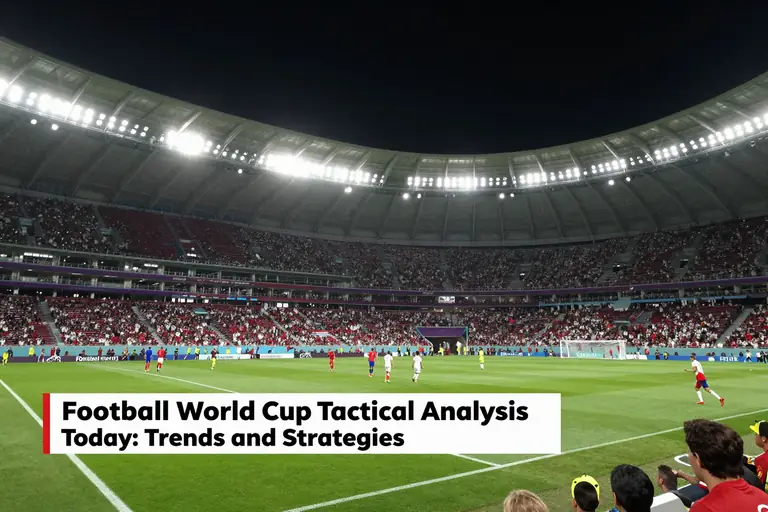
Football World Cup Tactical Analysis Today: The Evolving Landscape of Modern Football
The FIFA World Cup, a quadrennial spectacle, isn’t just about thrilling goals and dramatic upsets; it’s also a grand stage for tactical innovation and strategic brilliance. Every tournament brings new ideas, refined strategies, and a constant evolution of how the beautiful game is played. For anyone keen on understanding the intricacies beyond the scoreline, a detailed Football World Cup Tactical Analysis Today offers invaluable insights into the minds of coaches and the execution of their players, revealing the hidden chess match that unfolds on the pitch.
Gone are the days when a simple 4-4-2 or 4-3-3 was the be-all and end-all. While these foundational formations still exist, they are now incredibly fluid, adapting moment-to-moment based on possession, opponent, and game state. This fluidity is a cornerstone of any effective Football World Cup Tactical Analysis Today. Teams are no longer static entities but dynamic organisms, shifting shapes and roles with remarkable precision. This article delves into some of the key tactical trends and strategic masterstrokes observed in recent World Cups, offering a comprehensive look at the cutting-edge approaches defining contemporary international football.
The Rise of Positional Play and Control: A Symphony of Movement
One of the most noticeable shifts in recent years is the pervasive emphasis on positional play, often referred to as ‘Juego de Posición’ or ‘Positional Superiority.’ This isn’t merely about keeping the ball for the sake of it; it’s a sophisticated philosophy centered on using possession to create superior numerical and qualitative advantages in specific areas of the pitch. The objective is to systematically draw opponents out of position, create passing lanes, and then exploit the spaces created with incisive movements and passes. Teams employing this philosophy often prioritize technically gifted midfielders who possess exceptional spatial awareness, can dictate the tempo, and distribute the ball with precision. The ultimate goal is to control the game, not just physically, but mentally, exhausting the opposition and forcing them into critical mistakes.
This approach often manifests in highly flexible formations, such as a 4-3-3 that can seamlessly morph into a 3-4-3 in attack, with full-backs pushing high and wide to provide crucial width, while central midfielders drop deeper to aid in ball circulation and defensive cover. The inverted full-back, a relatively recent tactical innovation popularized by coaches like Pep Guardiola, has also gained significant prominence. These players move into central midfield areas when their team has possession, adding an extra body in the middle to help with build-up play, create numerical overloads, and provide an unexpected passing option. This complex interplay of roles, movements, and spatial occupation is a recurring and fascinating theme in any Football World Cup Tactical Analysis Today, showcasing the intricate dance between players and their designated zones.
Defensive Solidity and Counter-Attacking Prowess: The Art of the Quick Transition
While positional play dominates one end of the tactical spectrum, the art of defensive solidity combined with devastating counter-attacks remains a potent and often decisive weapon, particularly for underdog teams or those facing ostensibly superior opposition. A thorough Football World Cup Tactical Analysis Today would invariably highlight how teams are perfecting their compact defensive blocks, often operating in a low-to-mid block, denying space in crucial central areas, and forcing opponents wide into less dangerous zones. The focus here is on disciplined defending, collective pressing triggers, and incredibly quick transitions from defense to attack.
The beauty of a well-executed counter-attack lies in its speed, directness, and clinical efficiency. Once possession is won, often deep in their own half through a tackle or interception, teams look to bypass the midfield with rapid, incisive passes or direct long balls to fast attackers making intelligent runs in behind the defensive line. The effectiveness of this strategy often hinges on the blistering pace and clinical finishing of the forwards, as well as the exceptional vision and passing range of the players initiating the break. Understanding these dynamics – the moment of regaining possession, the immediate decision-making, and the execution of the final pass – is crucial for a complete Football World Cup Tactical Analysis Today. The ability to switch from a deeply entrenched defensive mindset to an explosive offensive one in mere seconds is a hallmark of tactically astute teams and often the difference between victory and defeat.
The Importance of Set Pieces and Game Management: Marginal Gains, Major Impact
In tightly contested matches, where open play goals are hard to come by and defenses are well-organized, set pieces can truly be game-changers. Corner kicks, direct and indirect free kicks, and even long throw-ins are no longer afterthoughts; they are meticulously planned and rehearsed routines, often involving complex movements and designated roles. A deep Football World Cup Tactical Analysis Today will invariably reveal the intricate routines teams employ, from decoy runs to specific blocking techniques, all meticulously designed to create a momentary numerical or spatial advantage and, crucially, a scoring opportunity. The ability to score from set pieces, or conversely, to defend them effectively without conceding, can often be the crucial difference between advancing to the next round and going home.
Beyond set pieces, game management has become an increasingly sophisticated and vital aspect of modern football. This encompasses a wide array of strategic decisions, including understanding precisely when to slow the pace to conserve energy or frustrate an opponent, when to accelerate it to exploit fatigue or momentum, when to make impactful substitutions, and how to effectively utilize psychological advantages or disadvantages. Coaches meticulously study opposition patterns, monitor player fatigue levels, and gauge the flow of the game to make critical, often split-second decisions that can swing momentum. This strategic oversight, often referred to as the ‘coach’s touch,’ is a significant part of any Football World Cup Tactical Analysis Today, highlighting the intense chess match played out on the sidelines as much as on the pitch. The judicious use of tactical fouls to break up dangerous attacks, for instance, or clever time-wasting techniques when holding a precarious lead, are all subtle yet intricate components of this high-stakes dance.
Player Versatility and Role Fluidity: The Modern Footballer’s Mandate
Modern football demands an unprecedented level of versatility from its players. The days of a player being confined to a single, rigid position with limited responsibilities are largely over. Today, wingers are expected to track back diligently and contribute defensively, full-backs are expected to provide significant offensive contributions and overlap, and even central defenders are now often tasked with initiating sophisticated build-up play from the back with precise passing. This inherent fluidity in roles and responsibilities allows teams to adapt seamlessly to different situations, respond effectively to various opponents, and makes them significantly less predictable and harder to break down. This adaptability, both individually and collectively, is a key element in any comprehensive Football World Cup Tactical Analysis Today.
Consider the evolution of specialized roles such as the “false nine” – a striker who drops deep into midfield, thereby pulling central defenders out of position and creating valuable space in behind for attacking midfielders or wingers to run into. Or the “inverted winger,” who plays on the opposite flank to their dominant foot, allowing them to cut inside onto their stronger foot to shoot or combine intricately with teammates in central areas. These specialized and highly demanding roles, and the exceptional players capable of executing them flawlessly, are vital components of contemporary tactical approaches, showcasing the blend of technical skill, tactical intelligence, and physical conditioning required at the elite level.
The Indispensable Role of Data and Analytics: The Science Behind the Strategy
Behind almost every tactical decision made today lies a mountain of meticulously collected and analyzed data. Performance analysts pour over statistics, tracking everything from individual player heat maps and intricate passing networks to defensive actions, pressing intensity, and expected goals (xG). This wealth of data provides coaches with objective, empirical insights into individual and team performance, helping them to accurately identify strengths, pinpoint weaknesses, and highlight specific areas for improvement. A thorough Football World Cup Tactical Analysis Today often incorporates these analytical findings to explain precisely why certain strategies were employed, how effective they proved to be, and what adjustments might be needed.
For instance, detailed data analysis can help identify opponent vulnerabilities, such as a consistent tendency to concede crosses from a particular flank, or a weakness in defending against through balls into the channels. Coaches can then meticulously tailor their tactical plans to exploit these specific weaknesses, giving their team a significant, data-driven advantage. The profound integration of technology and advanced analytics has fundamentally changed the way football is analyzed, prepared for, and ultimately played, making a Football World Cup Tactical Analysis Today even more intricate, precise, and data-driven than ever before. This scientific approach elevates the tactical discourse beyond mere observation to a realm of empirical evidence.
Examining Recent World Cup Trends: A Historical Perspective on Tactical Evolution
Looking back at recent World Cups, several clear tactical trends emerge that continue to shape the modern game. The 2014 World Cup, for example, saw Germany’s triumphant campaign built on a foundation of fluid positional play, exceptional technical ability, and an incredibly strong collective unit. Their ability to adapt their tactics mid-tournament and overcome challenges was a masterclass in tactical execution and collective intelligence. This period was crucial for a Football World Cup Tactical Analysis Today, showcasing the immense power of a well-drilled, adaptable, and technically proficient team.
In 2018, France’s memorable victory was characterized by a more pragmatic yet equally effective approach, combining rock-solid defensive solidity with devastating counter-attacks driven by blistering pace and immense power from players like Kylian Mbappé. Their ability to absorb intense pressure and then strike quickly and decisively was a testament to their tactical discipline and individual brilliance. This offered a different, yet equally compelling, angle for Football World Cup Tactical Analysis Today, highlighting the effectiveness of a more direct, transition-focused approach when executed with precision.
The most recent World Cup continued to showcase these evolving trends, with teams experimenting with variations of back-three formations, high-intensity pressing strategies, and increasingly intricate build-up play initiated directly from the goalkeeper. The emphasis on athletic, technically proficient players who possess the versatility to operate effectively in multiple roles was more apparent than ever. Each successive tournament adds new layers to the ongoing Football World Cup Tactical Analysis Today, demonstrating the relentless and continuous innovation within the sport, pushing the boundaries of what is tactically possible.
Looking Ahead: What’s Next in the Tactical Arms Race?
As football continues its rapid evolution, so too will its tactics and methodologies. We can anticipate an even greater emphasis on individualized player development, allowing coaches to craft highly specific and nuanced roles within their overarching tactical frameworks. The traditional lines between positions will likely blur even further, with players expected to contribute across all phases of play – attack, defense, and transition – with equal proficiency. The increasing integration of cutting-edge sports science, advanced psychology, and nutrition will also play an even more significant role in optimizing player performance and ensuring peak tactical execution.
The next World Cup will undoubtedly bring forth a fresh wave of tactical innovations and strategic masterpieces, continuing the sport’s fascinating evolution. A Football World Cup Tactical Analysis Today will always remain a dynamic and exciting field, perfectly reflecting the ever-changing nature of the beautiful game. From the intricate passing patterns and suffocating press of possession-based teams to the lightning-fast counter-attacks of defensive powerhouses, every match offers a rich and complex tapestry of tactical battles to unravel. Understanding these nuanced dynamics not only enhances the viewing experience but also provides a much deeper appreciation for the strategic genius behind the world’s most popular sport.
Ultimately, a comprehensive Football World Cup Tactical Analysis Today isn’t just about identifying what happened on the pitch; it’s about understanding precisely why it happened, and what its implications are for the future direction of football. It’s about recognizing the subtle shifts in philosophy, the bold experiments in formation, and the enduring principles that consistently define success on the biggest stage of all. The tactical arms race in football is relentless, and the World Cup serves as its ultimate proving ground. Every four years, we witness new chapters being written in the tactical playbook, making each Football World Cup Tactical Analysis Today a fresh, exciting, and intellectually stimulating endeavor.
The profound beauty of a Football World Cup Tactical Analysis Today lies in its unparalleled ability to reveal the intricate layers beneath the surface, transforming a seemingly simple game into a complex and captivating strategic challenge. It’s a powerful testament to the ingenuity and strategic foresight of coaches and the exceptional skill and intelligence of players who continuously push the boundaries of what’s possible on the pitch. As fans, delving into this detailed analysis allows us to appreciate the game on a much deeper, more informed level, recognizing the intricate dance of strategy, execution, and human endeavor that unfolds with every pass, tackle, and glorious goal.
FAQ
Q: What are some common tactical formations seen in a Football World Cup Tactical Analysis Today?
A: While formations are increasingly fluid, common starting points often observed in a Football World Cup Tactical Analysis Today include the 4-3-3, 4-2-3-1, 3-4-3, and 3-5-2. However, it’s crucial to remember that these often change dynamically and morph during a match based on possession phases, defensive requirements, and the opponent’s strategy.
Q: How important is player versatility in modern Football World Cup Tactical Analysis Today?
A: Player versatility is of paramount importance in modern football, as highlighted in any comprehensive Football World Cup Tactical Analysis Today. Contemporary tactics frequently require players to fulfill multiple roles, adapting seamlessly to different phases of play (attack, defense, transition) and covering various areas of the pitch. This inherent flexibility allows teams to be more unpredictable, robust, and capable of adapting to in-game situations, making individual player intelligence and adaptability critical.
Q: Do coaches rely heavily on data for their Football World Cup Tactical Analysis Today?
A: Absolutely. Coaches and their extensive backroom staff extensively use data and advanced analytics for their Football World Cup Tactical Analysis Today. This includes meticulously tracking individual player performance metrics, comprehensive team statistics, identifying specific opponent weaknesses through pattern recognition, and analyzing overall game trends. This data-driven approach informs tactical decisions, shapes training methodologies, and is crucial for meticulous match preparation, providing an objective foundation for strategic choices.
Q: What is ‘positional play’ and why is it significant in a Football World Cup Tactical Analysis Today?
A: Positional play, or ‘Juego de Posición,’ is a tactical philosophy focused on creating superior numerical and qualitative advantages in specific areas of the pitch through intelligent player positioning and movement. It’s significant because it aims to control the game through possession, systematically disrupt opponent formations, and create spaces for attacking opportunities. It requires highly technical and tactically intelligent players who can maintain shape while also being fluid in their movements to exploit openings.
Q: How has the role of full-backs evolved according to a Football World Cup Tactical Analysis Today?
A: The role of full-backs has evolved dramatically. Traditionally primarily defensive, modern full-backs are now expected to be significant contributors in attack, providing width, overlapping runs, and often delivering crosses or even cutting inside (inverted full-backs). They are also crucial in the build-up phase, initiating attacks from deep. This dual responsibility makes them among the most physically demanding and tactically important positions in modern football, as frequently observed in a Football World Cup Tactical Analysis Today.