
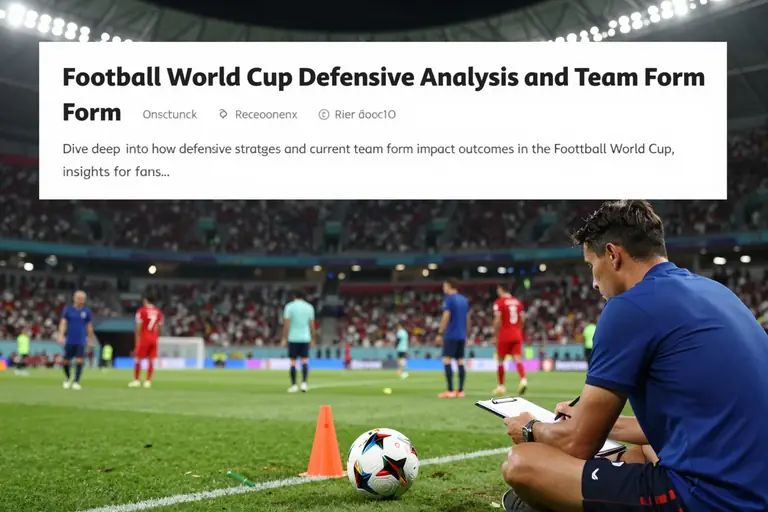
When it comes to the Football World Cup, the spotlight often falls on dazzling attackers and incredible goals. However, as we often see, a strong defense is usually the foundation of any successful campaign. Our analysis here focuses on how different defensive strategies play out on the biggest stage and how a team’s current form, particularly in their backline, can heavily influence their chances. It’s not just about keeping a clean sheet; it’s about controlling games, absorbing pressure, and providing a stable platform for the attacking players to shine.
We’ve observed that teams with well-drilled defensive units often go further than those relying solely on individual brilliance. This isn’t just about the four defenders; it’s a collective effort involving midfielders tracking back, wingers closing down, and even strikers initiating the press from the front. The World Cup’s high-stakes environment amplifies the importance of defensive solidity, where one mistake can be the difference between advancing and going home.
The Impact of Current Team Form on Defensive Performance
Team form heading into a major tournament like the World Cup is a critical indicator of potential success, especially concerning defensive capabilities. A team in good form usually exhibits confidence, cohesion, and a clear understanding of their roles, all of which are vital for a strong defense. This isn’t just about winning games; it’s about how those games are won. Are they conceding many chances? Are their defenders making crucial interventions? Are they organized during set pieces?
Conversely, a team struggling with form might show signs of defensive fragility: miscommunication, lapses in concentration, or an inability to cope with sustained pressure. These issues, if not addressed, can be ruthlessly exposed by world-class opponents. We always look at recent performances not just for results, but for the underlying patterns in their defensive play. A string of clean sheets against strong opposition, for example, signals a robust defense that can likely withstand World Cup challenges. On the other hand, even wins achieved while regularly conceding goals might hint at defensive vulnerabilities that could be exploited.
Key Defensive Formations and Their Effectiveness
Different defensive formations offer various strengths and weaknesses, and World Cup teams often adapt these based on their opponents and player personnel.
The traditional 4-4-2 formation, while sometimes seen as outdated, can offer excellent defensive shape and midfield compactness, making it difficult for opponents to play through the middle. Its effectiveness hinges on the work rate of the wide midfielders and strikers in tracking back.
The 4-3-3 or 4-2-3-1 formations often rely on a strong defensive midfield pivot to protect the back four. This allows full-backs to push higher up the pitch, contributing to attacks, but also leaves space in behind that must be covered quickly if possession is lost. The success of these systems defensively often depends on the central midfielders’ ability to win duels and shield the defense.
The increasingly popular 3-at-the-back systems (3-4-3, 3-5-2) aim to provide numerical superiority in central defense, making it harder for opposing strikers to find space. However, these systems demand highly athletic wing-backs who can cover the entire flank defensively and offensively. If the wing-backs are caught out of position, these formations can be vulnerable on the wide areas. Our site’s analysis often highlights how well teams execute these roles, as it’s a make-or-break aspect of such systems.
Player Watch: Defensive Pillars
Individual defenders, while part of a collective, often stand out as crucial pillars in their team’s defensive structure. We pay close attention to center-backs who demonstrate exceptional leadership, aerial prowess, and tactical intelligence. Their ability to read the game, organize the backline, and make timely interceptions is invaluable.
Full-backs who excel in both defensive duties and attacking contributions are also vital. Their energy and ability to cover ground are essential for teams that rely on wide play. Defensive midfielders, often unsung heroes, are critical in breaking up play, winning second balls, and protecting the central defensive areas. Their form and fitness can significantly impact a team’s ability to control the midfield and prevent attacks from reaching the final third. Keep an eye on players who consistently perform these roles at a high level; they are often the backbone of a deep tournament run.
Tactical Overview: Pressing and Counter-Pressing
Modern football places a huge emphasis on defensive tactics beyond just sitting deep. High pressing, where forwards and midfielders aggressively close down opponents in their half, aims to win the ball back quickly and high up the pitch. This strategy, when executed well, can disrupt an opponent’s build-up play and create immediate attacking opportunities.
Counter-pressing, which involves immediately trying to win the ball back after losing possession, is another key defensive tactic. It prevents opponents from launching quick counter-attacks and helps maintain offensive momentum. Both strategies require immense physical conditioning and tactical discipline from all players. When a team’s form is strong, these tactics often look seamless. When form dips, pressing can become uncoordinated, leaving gaps for opponents to exploit. We often analyze how effectively teams implement these high-intensity defensive approaches, as they are strong indicators of a team’s overall defensive cohesion and readiness.
Historical Context: Defense Wins Tournaments
Looking back at past World Cups, a recurring theme is the success of teams built on strong defensive foundations. While memorable attacking displays often capture the headlines, the teams that lift the trophy typically boast an impressive defensive record. The 2010 Spanish team, for example, conceded very few goals throughout their triumphant campaign. Similarly, Italy’s 2006 victory was largely attributed to their rock-solid defense.
This isn’t to say that attacking talent isn’t important, but rather that a balanced approach, with a particular emphasis on defensive solidity, often provides the necessary stability to navigate the pressures of a knockout tournament. History suggests that while individual attacking brilliance can win a single match, collective defensive strength is what wins the entire competition. Our coverage consistently highlights this balance, understanding that a deep run requires both.
FAQ
How important is defensive organization in the World Cup?
Defensive organization is extremely important; it forms the backbone of any successful World Cup campaign, allowing teams to absorb pressure and provide a platform for attacking players.
How does team form affect defensive performance?
Good team form usually means higher confidence and cohesion, leading to better defensive understanding and fewer mistakes, which is crucial for a strong backline.
What are common defensive formations seen in the World Cup?
Common defensive formations include the 4-4-2, 4-3-3, 4-2-3-1, and various 3-at-the-back systems (like 3-4-3 or 3-5-2), each with specific strengths and requirements.
Which types of players are key to a strong defense?
Key defensive players include strong, intelligent center-backs, athletic full-backs who can cover both ends of the pitch, and disciplined defensive midfielders who shield the defense.
Do high pressing tactics count as defensive analysis?
Yes, high pressing and counter-pressing are crucial modern defensive tactics aimed at winning the ball back quickly and disrupting opponent attacks, requiring collective defensive effort.