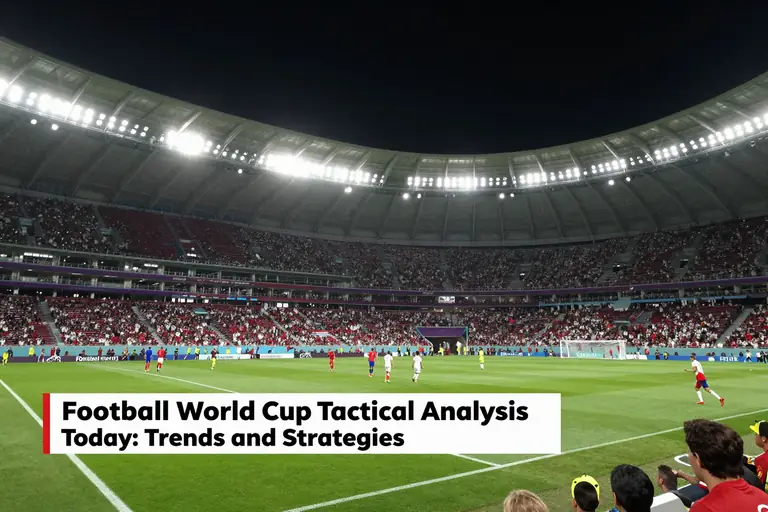
When you dive into a Football World Cup Tactical Match Report, you’re looking beyond the scoreline. We aim to break down the how and why of a match, offering a deeper understanding of the strategies employed by teams and the individual brilliance (or struggles) of players. This isn’t just about who won, but how they won, or why they lost, from a strategic perspective. Our goal is to give you the tools to interpret these reports, whether you’re a casual fan or an aspiring analyst.
Understanding a Tactical Match Report
A tactical match report serves as a detailed post-game analysis, moving beyond simple statistics to uncover the strategic narrative of a football match. It’s about deconstructing the decisions made by coaches, the execution by players, and the dynamic interplay between two opposing teams. For a major tournament like the Football World Cup, where stakes are incredibly high, these reports become invaluable for understanding the nuances that dictate success or failure. They provide a framework for appreciating the tactical chess match that unfolds on the pitch, highlighting moments of strategic genius or critical errors.
The Core Elements of Tactical Analysis
A comprehensive tactical match report typically covers several key areas. We often start with the team formations, as these set the initial framework for how a team intends to play. Then, we look at how these formations evolve throughout the match, especially after substitutions or in response to the opponent’s strategy.
Formation and Setup
Before kickoff, the announced lineups give us the starting formations – a 4-3-3, a 4-2-3-1, a 3-5-2, and so on. But these are just numbers. What truly matters is how players interpret their roles within that system. For instance, a 4-3-3 might play very differently depending on whether the wingers stay wide or cut inside, or if the central striker drops deep. A Football World Cup Tactical Match Report will highlight these nuances. We analyze if a team is set up to dominate possession, play on the counter, or press high up the pitch from the first whistle.
Possession and Control
Possession statistics are just numbers until you understand what a team does with the ball. Is it possession with purpose, leading to chances, or just sterile possession in non-threatening areas? A tactical report will examine how teams use possession to control the tempo, create overloads in specific areas, or draw opponents out of position. Conversely, we also look at how teams without the ball organize themselves – their defensive shape, pressing triggers, and how they transition from defense to attack.
Attacking and Defensive Strategies
On the attacking front, we scrutinize how goals are created. Are teams relying on wide play and crosses, intricate passing through the middle, set-pieces, or individual moments of brilliance? For defense, the report will detail how teams defend their box, deal with aerial threats, manage counter-attacks, and whether they employ man-marking or zonal marking systems. We also consider the effectiveness of their offside trap and how well their defenders communicate.
Key Player Roles and Contributions
Individual performances are crucial within any tactical framework. A tactical match report will often highlight specific players who were central to their team’s strategy.
The Midfield Battle
Often, the midfield is where games are won or lost. We look at the roles of holding midfielders in breaking up play and dictating tempo, box-to-box midfielders in linking defense and attack, and creative midfielders in unlocking defenses. Their ability to win duels, distribute the ball effectively, and track back is often pivotal.
Impact of Forwards and Defenders
Forwards are analyzed not just for goals, but for their movement off the ball, their ability to press defenders, and their link-up play. Defenders are assessed on their individual duels, their positioning, their ability to clear danger, and their contribution to building play from the back. Full-backs, in particular, are often key in modern football, providing width in attack and defensive cover.
Analyzing In-Game Adjustments
No game plan survives first contact with the enemy, as they say. The ability of coaches to make effective in-game adjustments is a hallmark of top-tier football.
Substitutions and Their Impact
Substitutions are more than just fresh legs. They can be tactical masterstrokes, changing a team’s formation, bringing on a player with a specific skill set to exploit an opponent’s weakness, or shoring up a defense. A good Football World Cup Tactical Match Report will analyze whether these changes had the desired effect and how the opposing team reacted.
Shifting Formations and Roles
Sometimes, a coach doesn’t even need to make a substitution to change tactics. Players might shift roles, a winger might drop deeper to help in midfield, or a full-back might become more conservative. These subtle shifts can significantly alter the flow of a match and are critical to identify in our analysis.
Understanding the Context: Pre-Match Expectations vs. Reality
Every World Cup match comes with its own narrative. Before the game, there are expectations based on team form, historical matchups, and player quality. A tactical report will often compare these pre-match expectations with the actual unfolding of events. Did a favored team struggle to break down an underdog’s defense? Did a team known for attacking prowess adopt a more conservative approach? Understanding these discrepancies helps us appreciate the tactical battle that took place.
The Importance of Data in Tactical Reports
While qualitative observations are vital, modern tactical reports are increasingly backed by data. Metrics like pass completion rates in specific zones, progressive passes, successful dribbles, defensive actions (tackles, interceptions, blocks), and expected goals (xG) provide objective insights. We use these statistics to support our observations and give a more complete picture of team performance. For example, high xG without many actual goals might indicate poor finishing, while a low xG despite plenty of possession suggests a lack of penetration.
Why Tactical Reports Matter for Fans
For us, a detailed Football World Cup Tactical Match Report enhances the viewing experience. It allows fans to appreciate the strategic chess match unfolding on the pitch, recognizing the intelligence behind a coach’s decisions and a player’s movements. It moves beyond simply celebrating goals to understanding the intricate processes that lead to them, or prevent them. This deeper insight helps foster a greater appreciation for the sport’s complexities.
FAQ
What is the main purpose of a Football World Cup Tactical Match Report?
Its main purpose is to analyze the strategic decisions, formations, player roles, and in-game adjustments made by teams during a match, explaining how these factors influenced the outcome beyond just the final score.
How do tactical reports analyze team formations?
They go beyond just listing numbers (e.g., 4-3-3) to explain how players interpret their roles within the system, whether wingers stay wide or cut in, and how the formation adapts to different phases of play or opponent strategies.
What role do individual players play in a tactical analysis?
Individual players are analyzed for their specific contributions within the team’s strategy, such as a midfielder’s ability to dictate tempo, a defender’s positioning, or a forward’s off-the-ball movement and pressing.
Why are in-game adjustments important to analyze?
In-game adjustments, like substitutions or shifts in player roles, can significantly alter a match’s dynamics. Analyzing them helps understand how coaches react to the opponent and try to gain an advantage.
Do tactical reports use statistics?
Yes, modern tactical reports often incorporate data such as pass completion rates, expected goals (xG), progressive passes, and defensive actions to provide objective support for qualitative observations and offer deeper insights.